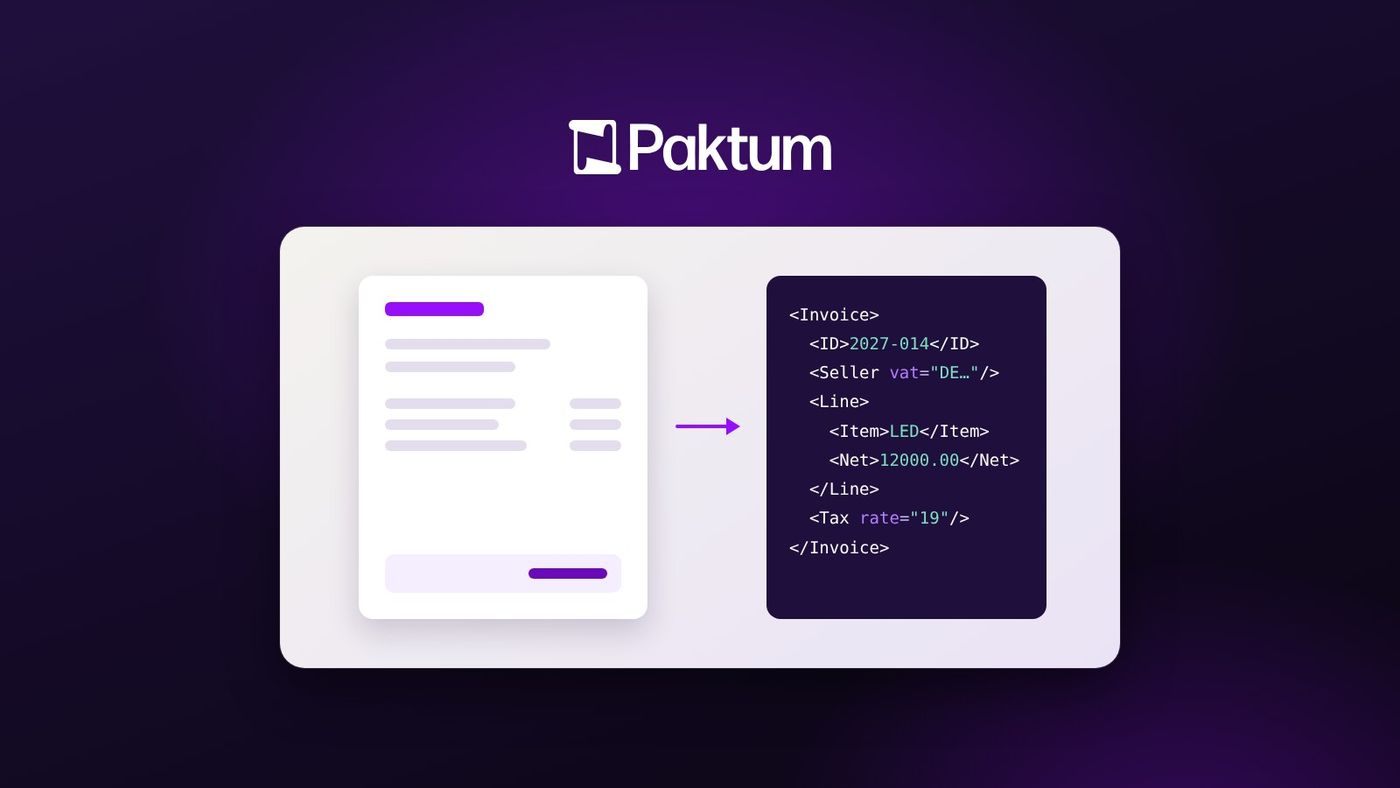
From 1 January 2027, a PDF invoice to your main sponsor is no longer enough if your club had a total turnover of more than €800,000 in the previous year (Section 27(38) of the German VAT Act, UStG). From 2028, this transitional rule ends for everyone. And you have had to be able to receive e-invoices since 1 January 2025.
Sponsorship invoices almost always go to companies, so they sit right in the B2B segment the mandate covers. If you still build invoices in Word and send them as PDFs, you need to switch before your first invoicing run in 2027.
We build Paktum, a sponsorship management platform that generates sponsorship invoices as XRechnung and ZUGFeRD files. This article sums up what the law, the Federal Ministry of Finance (BMF) and the regional sports federations say. For the full picture, read the complete guide to sponsorship management.
Key takeaways
You have had to be able to receive e-invoices since 1 January 2025. An ordinary email inbox is enough (BMF circular of 15 October 2025).
For services supplied from 1 January 2027, e-invoices to sponsors are mandatory if your club's total turnover in 2026 exceeded €800,000. From 1 January 2028, there is no transitional rule left (Section 27(38) UStG).
A PDF sent by email is not an e-invoice. Formats compliant with EN 16931 are permitted, such as XRechnung or ZUGFeRD from version 2.0.1, excluding the MINIMUM and BASIC-WL profiles (BMF circular of 15 October 2025).
Exemptions apply to small businesses under Section 19 UStG, small-amount invoices up to €250 and VAT-exempt supplies under Section 4 nos. 8 to 29 UStG (Sections 33 and 34a UStDV, BMF).
What is an e-invoice, and what isn't?
An e-invoice is an invoice that is issued, transmitted and received in a structured electronic format that allows electronic processing (Section 14(1) UStG). The format must comply with the European standard EN 16931 or be interoperable with it. Everything else is an “other invoice” (sonstige Rechnung): paper, but also PDF files without embedded data, image files or details in the body of an email (BMF circular of 15 October 2025, section 14.1(2) of the VAT Application Decree, UStAE).
So the nicely designed PDF invoice you send to your sponsor's marketing department is not an e-invoice, even if it arrives by email. Two formats are common in Germany:
XRechnung: a purely structured XML format, operated by KoSIT, the German coordination office for IT standards. Version 3.0 currently applies and remains in force until at least 31 July 2027 (KoSIT, xeinkauf.de).
ZUGFeRD: a hybrid format from FeRD, the German e-invoicing forum: a PDF/A-3 file with embedded XML data. ZUGFeRD counts as an e-invoice from version 2.0.1, excluding the MINIMUM and BASIC-WL profiles (BMF circular of 15 October 2025). The current version is 2.5.2 (FeRD, August 2026).
According to the BMF, which permitted format you use is a matter of civil law between you and your sponsor. With ZUGFeRD, the structured data takes precedence over the visual part (BMF, section 14.4(3) UStAE). And a file with format errors is not an e-invoice but an “other invoice”. You check this with a validation tool (BMF circular of 15 October 2025, para. 6a), such as KoSIT's open-source validator.
When does mandatory e-invoicing apply?
The mandate comes in stages. All domestic businesses have had to be able to receive e-invoices since 1 January 2025, while transitional rules for issuing apply until the end of 2027 (Section 27(38) UStG). What counts is when the service is supplied, not the invoice date.
Service supplied | Receiving | Issuing to businesses in Germany |
|---|---|---|
2025 and 2026 | Mandatory | Paper allowed, PDF or other electronic format with the recipient's consent |
2027 | Mandatory | E-invoice mandatory. Exception: total turnover in the previous year of no more than €800,000, then paper or, with consent, PDF still possible. EDI procedures remain possible with consent |
from 2028 | Mandatory | E-invoice mandatory, no transitional rule |
The €800,000 threshold refers to total turnover (Gesamtumsatz) under Section 19(2) UStG in the previous year: the sum of taxable supplies minus certain exempt supplies, not the sum of all income. For 2027, your 2026 total turnover is what counts. If your club is close to the threshold, check with your tax adviser which income is included.
On 15 October 2026, the BMF published a third circular, covering topics such as invoice correction and penalty provisions (IHK Berlin). The Berlin Chamber of Commerce does not mention any changed deadlines.
Note: This is not tax or legal advice. Information as of: 28 October 2026. Check your specific obligations with your tax adviser.
Is your club affected by mandatory e-invoicing?
As a rule, yes. Non-profit clubs (gemeinnützige Vereine) count as businesses if they are not active exclusively in the non-commercial, mission-driven sphere (ideeller Bereich) (LSB Niedersachsen, VIBSS, 2026). Any club that sells perimeter boards, shirt space or hospitality practically always qualifies. What matters is where income lands for tax purposes:
Non-commercial sphere (ideeller Bereich): The tax authorities do not treat a mere mention of a sponsor without emphasis as an exchange of services (VIBSS, Sponsoring und Umsatzsteuer). No service means no invoice, and therefore no e-invoice.
Commercial operations (wirtschaftlicher Geschäftsbetrieb): Active advertising such as shirt and perimeter board advertising belongs here, and the income is subject to 19% VAT (VIBSS).
Asset management (Vermögensverwaltung): Leased advertising rights land here, except for advertising on sportswear and sports equipment (VIBSS, Verpachtete Werberechte).
VAT-exempt supplies: Supplies under Section 4 nos. 8 to 29 UStG, such as course fees or entry fees for sporting events, are not covered by the mandate (LSB Niedersachsen).
There are two further exemptions. Small businesses (Kleinunternehmer) whose total turnover was no more than €25,000 in the previous year and does not exceed €100,000 in the current year (Section 19(1) UStG) may always send “other invoices” (Section 34a UStDV). The same applies to small-amount invoices up to €250 (Section 33 UStDV).
Important: these exemptions only apply to issuing invoices. You still have to be able to receive e-invoices, even as a small business (BMF circular of 15 October 2025, section 14.1(5) UStAE). This applies to every club that receives invoices for asset management, tax-privileged activities (Zweckbetrieb) or commercial operations (LSB Niedersachsen). Your caterer or board manufacturer may send you e-invoices without your consent.
What does this mean for your sponsorship invoices?
Almost every sponsorship invoice falls under the mandate, because the sponsor purchases the advertising service for its business. If both parties are based in Germany, the invoice must be issued as an e-invoice, without the sponsor's consent (Section 14(2) UStG, BMF section 14.1(4) UStAE). Day to day, this means:
Instalment and season invoices: An invoice is any document used to bill a service (Section 14(1) UStG). So every instalment needs the e-invoice format. For advance payments, you issue the invoice within six months of receiving the payment (BMF, section 14.1(3) UStAE).
Contract as invoice: A sponsorship contract containing all mandatory details can be an invoice, but as a PDF it is only an “other invoice”. If the mandate applies, you need an additional e-invoice (BMF, section 14.1(17) UStAE). For continuing obligations, one e-invoice for the first period with the contract attached is enough until mandatory details change (para. 19). Check with your tax adviser whether this fits your contract.
Sponsor abroad: If one of the parties is not established in Germany, there is no e-invoicing obligation (BMF, section 14.1(6) UStAE). A Swiss sponsor without an involved German permanent establishment can still receive paper or, with consent, a PDF.
Marketing agency: If you lease rights to an agency, you invoice the agency and the agency invoices the sponsors. Both relationships are between businesses. Read more in the article on sponsor management for sports marketing agencies.
Barter deals: Vehicles in return for advertising are an exchange-like transaction (tauschähnlicher Umsatz, Section 3(12) UStG), and the club supplies a taxable advertising service (Federal Fiscal Court, 4 September 2008, as reported by Deubner). The same rules as for cash payments therefore apply to the invoice for it. Agree the valuation with your tax adviser.
A content error, such as a wrong VAT rate, hits your sponsor directly: it can only deduct input VAT once a corrected e-invoice is available (IHK Köln on the BMF circular of 15 October 2025). Clean master data is therefore also partner care.
How do you prepare your club office?
In six steps, and most of them take more coordination than technology:
Make sure you can receive: An ordinary email inbox is enough (BMF, section 14.1(5) UStAE). But you must be able to read, check and book XML files. If you refuse an e-invoice, you have no right to a PDF instead.
Check your 2026 total turnover: If it exceeds €800,000, the issuing obligation applies to services supplied from 1 January 2027.
Clean up master data: Mandatory details must be in the structured dataset, and a reference to external documents is not enough (IHK Köln). In XRechnung, “Buyer reference” (BT-10) is a mandatory field (BMF, para. 6b). Ask your sponsors which reference they expect.
Choose software and format: Agree the format with your largest sponsors and validate every invoice before sending it. Data should flow into accounting without retyping.
Settle archiving: For VAT purposes, you keep invoices for eight years, and for e-invoices at least the structured part must be kept unaltered in its original form (BMF, para. 60). The PDF image alone is not enough (IHK Köln). The GoBD, Germany's principles for proper electronic bookkeeping and archiving, also continue to apply (BMF, para. 61).
Involve your tax adviser: Allocating income, total turnover, barter and recurring invoices are case-by-case questions.
If your sponsorship data still lives in Excel, e-invoicing is a good reason to switch. The article Sponsor management instead of Excel shows how.
How does Paktum handle e-invoicing?
Paktum generates sponsorship invoices directly from contract data as XRechnung or ZUGFeRD files compliant with EN 16931, and validates them against the official KoSIT rule sets. No contract detail has to be copied into an invoice template by hand.
Payment schedules: Instalments, season invoices and additional services are created automatically when they fall due.
Barter deals: You record in-kind deals directly in the contract, alongside term and notice period.
Accounting: An interface to your accounting software, or handover to tools such as sevdesk, Lexware or easybill.
Agencies: Separate datasets for each client and a consolidated view.
At a 2. Bundesliga club (Germany's second football division), invoicing effort fell by 85%, and the switch uncovered €28,500 in invoices that had never been issued the previous season (Paktum customer data, season 23/24, anonymised). Gregor Rustige, Managing Director of the Bietigheim Steelers: “Invoicing with Paktum is much faster and more reliable, and we have more time to acquire new sponsors.” The case study Automating invoicing in sponsorship shows how the invoicing run is set up.
Does mandatory e-invoicing also apply in Switzerland and Austria?
No, neither country has a comparable B2B mandate today. In Switzerland, e-invoicing between businesses is voluntary (Avalara, as of May 2026). It has been mandatory since 2016 only for suppliers to the federal administration with a contract value above CHF 5,000 (Swiss Federal Department of Defence). In Austria, structured e-invoices are currently mandatory only for invoices to the federal government (WKO, 2026; European Commission). In connection with the EU's ViDA initiative, the Austrian Economic Chamber (WKO) names 1 July 2030 as the date for mandatory structured invoices.
For Swiss clubs with German sponsors, the German mandate does not apply as long as the club is not established in Germany and no German permanent establishment is involved (BMF, section 14.1(6) UStAE).
Conclusion
Mandatory e-invoicing hits sports clubs where the money comes in: sponsorship invoices. For services supplied from 1 January 2027, clubs with more than €800,000 total turnover in the previous year must issue e-invoices, and from 2028 everyone else must too. They already have to be able to receive e-invoices today.
Technology is the smaller part. The bigger effort lies in clean master data, a clear payment schedule for each contract and archiving that preserves the structured part. If you set this up now, you will start 2027 without queries from your sponsors' accounts departments.
If you want to switch your sponsorship invoices to XRechnung or ZUGFeRD in good time, book a demo with Paktum.
Frequently asked questions (FAQ)
Is a PDF invoice sent by email an e-invoice?
No. An e-invoice must be issued, transmitted and received in a structured electronic format compliant with EN 16931 (Section 14(1) UStG). A PDF without embedded data is an “other invoice” (BMF). ZUGFeRD looks like a PDF but contains XML data, and from version 2.0.1, excluding the MINIMUM and BASIC-WL profiles, it counts as an e-invoice.
Does a non-profit club have to be able to receive e-invoices?
Yes, as soon as it carries out business activities. Non-profit clubs count as businesses if they are not active exclusively in the non-commercial sphere (LSB Niedersachsen). The obligation to receive has applied since 1 January 2025, including for small businesses (BMF). An existing email inbox is enough, but you must be able to process the XML data.
Does the €800,000 threshold refer to the whole club's turnover?
What counts is the invoice issuer's total turnover in the previous year under Section 19(2) UStG (Section 27(38) UStG). This is the sum of taxable supplies minus certain exempt supplies, not the sum of all income. For services in 2027, total turnover in 2026 is what matters. Check with your tax adviser exactly what is included.
Do clubs that are small businesses have to issue e-invoices?
No. Invoices from small businesses may always be sent as “other invoices”, meaning on paper or, with consent, as a PDF (Section 34a UStDV). A small business is one whose total turnover was no more than €25,000 in the previous year and does not exceed €100,000 in the current year (Section 19(1) UStG). You must still be able to receive e-invoices.
Do I need a separate e-invoice for every sponsorship instalment?
In principle, every bill for a service is an invoice and needs the e-invoice format once the mandate applies. For continuing obligations, the BMF accepts one e-invoice for the first period with the contract attached. If the mandatory details change, you need a new one. Check with your tax adviser whether your sponsorship contract qualifies.
Sources
German Federal Ministry of Justice, VAT Act (UStG) Section 14 Issuing invoices (current version), accessed 28 October 2026, https://www.gesetze-im-internet.de/ustg_1980/__14.html (in German)
German Federal Ministry of Justice, VAT Act (UStG) Section 27(38) Transitional rules for e-invoicing (current version), accessed 28 October 2026, https://www.gesetze-im-internet.de/ustg_1980/__27.html (in German)
German Federal Ministry of Justice, VAT Act (UStG) Section 19 Small businesses (current version), accessed 28 October 2026, https://www.gesetze-im-internet.de/ustg_1980/__19.html (in German)
German Federal Ministry of Justice, VAT Act (UStG) Section 3(12) Exchange and exchange-like transactions (current version), accessed 28 October 2026, https://www.gesetze-im-internet.de/ustg_1980/__3.html (in German)
German Federal Ministry of Justice, VAT Implementing Regulation (UStDV) Section 33 Small-amount invoices (current version), accessed 28 October 2026, https://www.gesetze-im-internet.de/ustdv_1980/__33.html (in German)
German Federal Ministry of Justice, VAT Implementing Regulation (UStDV) Section 34a Invoices from small businesses (current version), accessed 28 October 2026, https://www.gesetze-im-internet.de/ustdv_1980/__34a.html (in German)
German Federal Ministry of Finance (BMF), circular “Einführung der obligatorischen elektronischen Rechnung bei Umsätzen zwischen inländischen Unternehmern ab dem 1. Januar 2025; Anpassung des Umsatzsteuer-Anwendungserlasses” (15 October 2025), full text as copy on steuerschroeder.de, accessed 28 October 2026, https://www.steuerschroeder.de/blog/wp-content/uploads/2025/10/2025-10-15-einfuehrung-obligatorische-e-rechnung.pdf (in German)
KPMG, BMF: Einführung der E-Rechnung ab 1. Januar 2025 (October 2025), accessed 28 October 2026, https://kpmg.com/de/de/home/themen/2025/10/bmf-ust-e-rechnung-neu.html (in German)
IHK Köln, Neues BMF-Schreiben zur E-Rechnung vom 15. Oktober 2025, accessed 28 October 2026, https://www.ihk.de/koeln/hauptnavigation/recht-steuern/steuern/bmf-schreiben-zur-e-rechnung-vom-15-10-2025-6774012 (in German)
IHK Berlin, E-Rechnung: Ab 2025 Pflicht (with reference to the BMF circular of 15 October 2026), accessed 28 October 2026, https://www.ihk.de/berlin/service-und-beratung/recht-und-steuern/steuern-und-finanzen/erechnung-6184420 (in German)
KoSIT / xeinkauf.de, XRechnung, accessed 28 October 2026, https://xeinkauf.de/xrechnung/ (in German)
FeRD, ZUGFeRD (information package ZUGFeRD 2.5.2 of 4 August 2026), accessed 28 October 2026, https://www.ferd-net.de/standards/zugferd (in German)
LSB Niedersachsen / VIBSS, Elektronische Rechnungen (Dietmar Fischer, 21 January 2026), accessed 28 October 2026, https://lsb-niedersachsen.vibss.de/vereinsmanagement/steuern/elektronische-rechnung (in German)
LSB Niedersachsen / VIBSS, Sponsoring und Umsatzsteuer: Ein weites Feld, accessed 28 October 2026, https://lsb-niedersachsen.vibss.de/vereinsmanagement/steuern/koerperschaft-gewerbe-und-umsatzsteuer/sponsoring-und-umsatzsteuer-ein-weites-feld-1 (in German)
VIBSS, Verpachtete Werberechte (Elmar Lumer, as of February 2024), accessed 28 October 2026, https://www.vibss.de/vereinsmanagement/steuern-finanzen/steuerliche-taetigkeitsbereiche/sponsoring/verpachtete-werberechte (in German)
Deubner Verlag, Redaktion Steuern, Wie wird das Sponsoring eines Vereins umsatzsteuerlich beurteilt? (2 November 2010, on the Federal Fiscal Court ruling of 4 September 2008), accessed 28 October 2026, https://www.deubner-steuern.de/news/steuerberatung/details/artikel/wie-wird-das-sponsoring-eines-vereins-umsatzsteuerlich-beurteilt.html (in German)
Avalara, E-invoicing in Switzerland (as of 1 May 2026), accessed 28 October 2026, https://www.avalara.com/vatlive/en/country-guides/europe/switzerland/switzerland-e-invoicing.html
Swiss Federal Department of Defence (VBS), Swiss Armed Forces, E-Rechnung, accessed 28 October 2026, https://www.vtg.admin.ch/de/e-rechnung (in German)
WKO, E-Rechnung Umsatzsteuer: Detailinfos (31 March 2026), accessed 28 October 2026, https://www.wko.at/oe/news/e-rechnung-umsatzsteuer-detailinfos-31-3-2026.pdf (in German)
European Commission, eInvoicing in Austria (as of October 2026), accessed 28 October 2026, https://ec.europa.eu/digital-building-blocks/sites/spaces/DIGITAL/pages/467108876/eInvoicing+in+Austria
Paktum, customer data from a project at a 2. Bundesliga club, season 23/24 (internal analysis, anonymised)