Germany is Europe's largest sponsorship market, worth €6.26 billion (ESA/Nielsen Sports, 2026). Yet a large share of this revenue still runs through Excel lists, Word contracts and email inboxes. This is exactly where professional sponsorship management comes in: as an operational process, not an address list.
German search results split the topic oddly neatly. On one side sits “which tool”, on the other “how is sponsorship taxed”. Hardly anyone explains the actual day-to-day operation. This guide closes that gap: it describes the complete sponsorship management lifecycle and links to an in-depth article for each stage.
At Paktum, we build sponsorship management software. This guide draws on our migration and operations projects with clubs and agencies.
Key takeaways
Sponsorship management is not a CRM side issue. It is the operational process from acquisition through contract, inventory and invoicing to reporting.
Germany is Europe's largest sponsorship market at €6.26 billion (ESA/Nielsen 2026), and around 94% of audited spreadsheets contain errors (Panko).
From 2027/2028, sponsorship invoices in Germany must be issued in a structured electronic format (mandatory e-invoicing, or E-Rechnungspflicht, according to the German Federal Ministry of Finance, BMF). Excel workflows reach their limits.
One second-division club saved 40 minutes per contract and 85% of its invoicing effort after switching (Paktum customer data, anonymised).
Contents
What is sponsorship management?
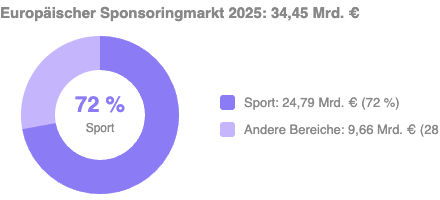
Sponsorship management is the end-to-end process a club uses to acquire, contract, deliver and bill its sponsorship rights. It covers inventory, contracts, invoicing and reporting, not just relationship management. Sport accounts for 72% of the European sponsorship market, or €24.79 billion (ESA/Nielsen Sports, 2026).
The most common misconception is: “That's just CRM.” A standard CRM manages contacts and deals. But it knows nothing about your perimeter board allocations, the notice periods in your contracts or the rules of e-invoicing. Sponsorship management covers exactly this operational layer.
Three terms come up again and again, so here are quick definitions:
Inventory: all saleable rights and spaces, such as perimeter boards, shirt sponsorship, hospitality or LED airtime.
Deliverables: what your club specifically owes the sponsor, for example eight metres of perimeter boarding across a season.
Activation: the actual delivery of what was sold.
One distinction to note: sponsorship is not a synonym for donation. Sponsorship involves something in return, a donation does not. This has tax consequences. More on that in the FAQ section.
Why is sponsorship management becoming a priority in 2026?
The European sponsorship market reached €34.45 billion in 2025, up 4.7% (ESA/Nielsen Sports, 2026). Germany is the largest single market in Europe at €6.26 billion. That money needs to be managed professionally.
 The base is broad. Germany has around 86,000 sports clubs with roughly 29.3 million memberships, a record and an increase of 2.18% (DOSB, the German Olympic Sports Confederation, membership survey 2025, reference date 1 January 2025). For many of these clubs, sponsorship is a material source of income.
The Sport Development Report (Sportentwicklungsbericht) shows just how material. Sponsorship, advertising and donations together account for around 14% of revenue in grassroots sport, roughly €600 million in absolute terms (Prof. Dr. Christoph Breuer, German Sport University Cologne, statement to the Sports Committee of the German Bundestag, 2024). That is no longer a marginal figure you can maintain in a spreadsheet on the side.
The market gap is striking: almost all content that ranks in search targets small amateur clubs. Professional clubs and agencies that manage several rights holders are effectively left unserved. Yet these are exactly the two groups that need the most structure.
How does professional sponsorship management work? (The lifecycle)
Professional sponsorship management follows a six-stage lifecycle: acquisition, contract, inventory, activation, invoicing and reporting. Each stage generates data for the next. After switching, a club in Germany's second division (2. Bundesliga) saved 40 minutes per contract and shortened its sales process by 30% (Paktum customer data, 2023/24 season, anonymised).
No ranking article connects these stages into one process. Software suites list features, directories compare vendors, tax sites explain the law. The value lies in the chain:
Acquisition and pipeline: make open deals visible, with closing probability and weighted value. More on this in the section on contracts.
Contract: map terms, notice periods and automatic renewals accurately.
Inventory: track sold rights against available allocations, without double bookings.
Activation: what was sold actually gets delivered, with tasks and deadlines.
Invoicing: based on the payment schedule, compliant and without manual retyping.
Reporting: contracted revenue, forecast and utilisation at the push of a button.
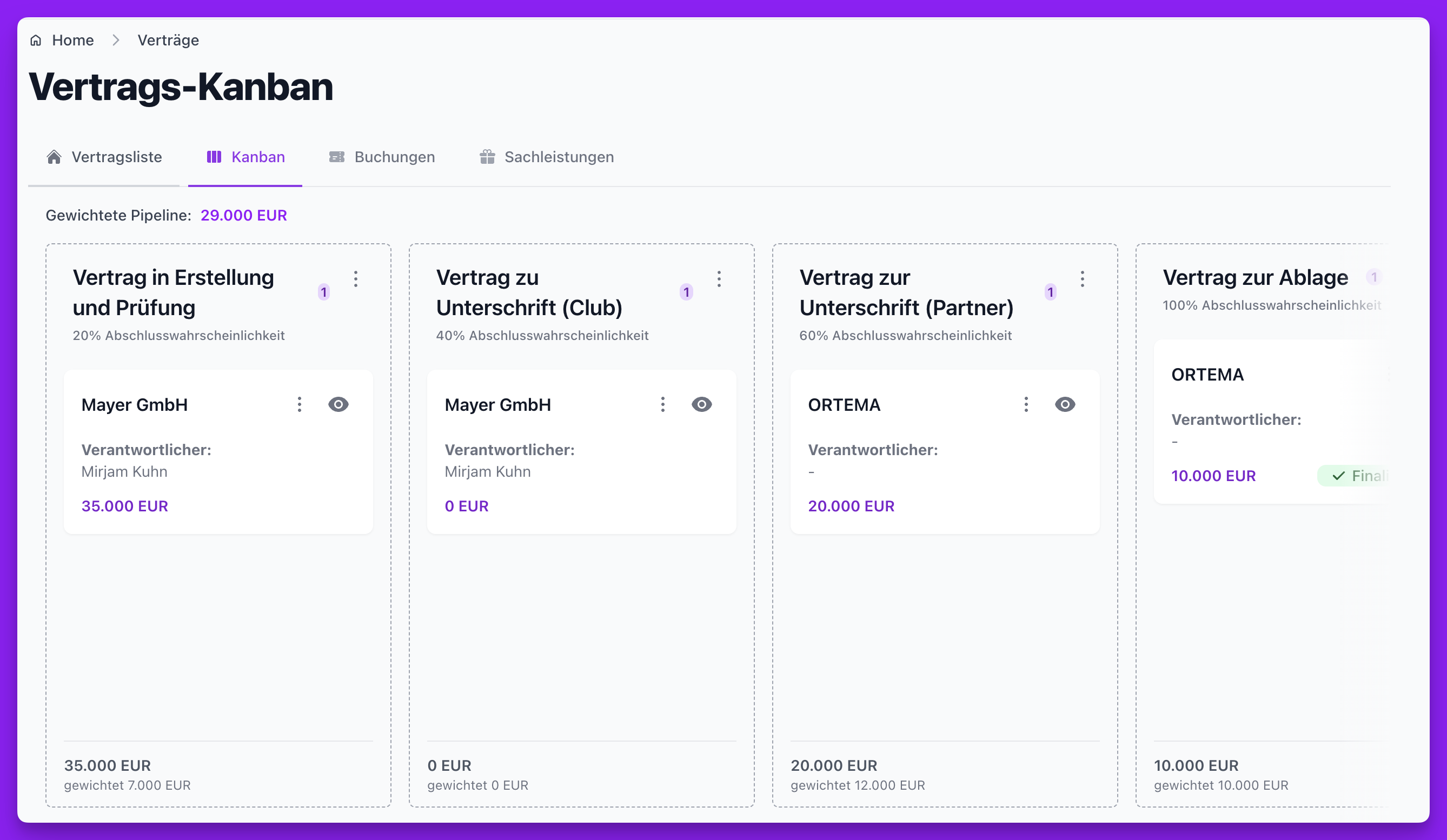 In our projects, the biggest impact does not come from any single stage but from the handovers between them. When a signed contract automatically blocks inventory, creates tasks and fills the invoicing schedule, manual follow-up work disappears. A sponsorship management platform like Paktum maps this chain in one place, as the feature overview shows.
How do you manage sponsorship inventory and deliverables?
Treat your inventory like stock: every perimeter board, every box, every shirt package as a line item with price, unit and allocation. That is the only way to avoid selling space twice or leaving it unused. Around 60% of grassroots sports clubs receive sponsorship, averaging about €8,400 per club (VSA study, 2026).
Three rules make the difference:
Track allocations per season: booked, reserved and available units are calculated per season, including for deals still under negotiation.
Detect double bookings: the same item can only be assigned once in the same period. A renewal in the following season is not a double booking.
Build bundles properly: several rights as one package, but with a correct availability calculation behind it.
[SCREENSHOT: Visual position planner in Paktum, stadium or racecourse map with booked and available advertising spaces. Alt: “Interactive position planner with colour-coded booked and available advertising spaces on a venue map”]
The visual position planner works beyond the stadium. A racing club uses it to map its racecourse and grandstands, a basketball club its floor stickers. Visible inventory makes the sales conversation concrete: the sponsor sees exactly where their logo will appear.
Inventory is a discipline of its own, with its own pricing logic.
How do you win sponsors and structure contracts?
Treat winning sponsors as a sales process, not as asking for favours. Offer, pricing, pipeline and closing follow the same rules as in classic sales. The demand is there: around 60% of grassroots sports clubs already receive sponsorship (VSA study, 2026). The bottleneck is rarely interest. It is the structure behind it.
When it comes to contracts, the details decide how well you can plan:
Terms and notice periods: clearly defined, so renewals don't get lost in your inbox.
Automatic renewal: a contract renews itself when the notice window closes, and a timely termination stops it.
Barter deals: in-kind contributions such as equipment in exchange for advertising are valued for what they are: a service with a real value.
Agencies face an additional dimension. If you manage several clubs or leagues, you need separate data for each client and still a consolidated view. Infront supports Paktum as its agency development partner. Our article on sponsorship management for agencies explains how multi-client sponsorship management works.
Invoicing and mandatory e-invoicing: what applies from 2027/2028
Sponsorship invoices in Germany will soon have to be structured. Since 1 January 2025, the law has required businesses to be able to receive e-invoices. The obligation to issue them starts on 1 January 2027 for companies with prior-year revenue of more than €800,000, and from 1 January 2028 it applies to all B2B transactions (BMF, as of March 2026). The standard is EN 16931, implemented as XRechnung or ZUGFeRD, the two German e-invoice formats.
Note: This is not tax or legal advice. Information as of 8 July 2026. Check your specific obligations with your tax adviser.
In practice, this means a PDF invoice created in Word no longer meets the requirement. What you need is a structured, machine-readable format. That is hard to keep clean manually, especially with dozens of sponsor invoices per season.
A sponsorship management platform generates XRechnung and ZUGFeRD invoices according to EN 16931, validated against the official KoSIT rule sets (KoSIT is Germany's public coordination office for IT standards). Alternatively, it passes the invoice on to existing accounting tools such as sevdesk, Lexware or easybill, so your tax adviser can keep working in their familiar workflow.
Our article on sponsorship invoicing shows how to automate your invoice runs in practice. For what mandatory e-invoicing means for clubs in detail, read our article on mandatory e-invoicing for clubs.
How do you measure the value of your sponsorship? (ROI, KPIs and ESG)
You measure value along two axes: contracted revenue and weighted pipeline. The first shows what is already secured, the second what is realistically still to come. On sustainability: as of 2024, 13 of 18 Bundesliga clubs and 3 of 18 second-division clubs were subject to sustainability reporting requirements (KPMG, 2024).
The most important chart for any board is the backlog curve. It shows how much revenue per season is already secured by signed contracts, and where that curve drops off. This “cliff” is the real sales target: take action in time, before the gap opens up.
The run-to-term logic is important. A terminated contract keeps counting until its actual end date, because the revenue is secured. That way, your reporting never understates what has actually been signed.
The demand for ESG data increasingly comes from sponsors themselves. Brands want evidence of reach, target audiences and sustainability to justify their investment internally. For a long time, the CSRD (the EU Corporate Sustainability Reporting Directive) was the legal framework for this. The EU Omnibus package (2025) raised the thresholds and postponed deadlines, so currently hardly any clubs are directly subject to reporting. Check the final status before making any decision. Sponsors' expectation of evidence remains unaffected.
For how to set up KPIs and forecasts, see our in-depth guide on measuring sponsorship ROI.
Excel, standard CRM or specialist software?
The decision depends on error risk and process depth. Excel is cheap to start with and expensive to run: around 94% of audited operational spreadsheets contain errors, with a cell error rate of 5.2% (Ray Panko, University of Hawaii). With contracts, allocations and invoices, that is not a cosmetic flaw but a business risk.
At the same second-division club, the switch uncovered €28,500 in invoices that had simply never been issued in the previous season (Paktum customer data, anonymised). This is exactly the kind of money that disappears in scattered lists.
<figure>
<svg viewBox=“0 0 680 200” xmlns=“http://www.w3.org/2000/svg” role=“img” aria-label=“Horizontal bar chart: after introducing Paktum at a second-division club, time per contract fell by 40 minutes, sales process duration by 30 percent and invoicing effort by 85 percent.” font-family=“sans-serif”>
<text x=“0” y=“18” font-size=“15” font-weight=“600” fill=“#888”>Results after rollout (2. Bundesliga club)</text>
<text x=“0” y=“58” font-size=“13” fill=“#888”>Time per contract</text>
<rect x=“0” y=“66” width=“200” height=“22” rx=“4” fill=“#C4B5FD”/>
<text x=“212” y=“82” font-size=“13” font-weight=“600” fill=“#888”>−40 min</text>
<text x=“0” y=“112” font-size=“13” fill=“#888”>Sales process duration</text>
<rect x=“0” y=“120” width=“126” height=“22” rx=“4” fill=“#A78BFA”/>
<text x=“138” y=“136” font-size=“13” font-weight=“600” fill=“#888”>−30%</text>
<text x=“0” y=“166” font-size=“13” fill=“#888”>Invoicing effort</text>
<rect x=“0” y=“174” width=“357” height=“22” rx=“4” fill=“#8B7CF6”/>
<text x=“369” y=“190” font-size=“13” font-weight=“600” fill=“#888”>−85%</text>
</svg>
<figcaption>Source: Paktum customer data (anonymised), 2. Bundesliga club, 2023/24 season</figcaption>
</figure>
A standard CRM is the intermediate step that often falls short. It knows contacts and deals, but not allocations, termination logic or e-invoicing.
Professional leagues now use specialist software too. The DEL2 (Germany's second-tier ice hockey league) and the Volleyball Bundesliga (VBL) use Paktum at league level. The VBL publicly called Paktum a “game changer” and a “Swiss Army knife” for its partner management.
The article migrating from Excel to sponsorship management walks you through the actual switch.
Frequently asked questions (FAQ)
What is the difference between sponsorship and a donation for a club?
Sponsorship is an exchange of services: the sponsor pays and receives something in return, such as advertising. A donation is given free of charge, with nothing in return. The difference matters for tax purposes, because sponsorship usually has a commercial connection, whereas a donation belongs to the club's non-profit core sphere (the “ideeller Bereich” in German tax law).
Does a club have to issue an invoice and pay VAT on sponsorship?
Usually, yes. Passive sponsorship, such as simply naming the sponsor, often receives favourable tax treatment. Active sponsorship such as perimeter board or shirt advertising counts as a commercial business operation (wirtschaftlicher Geschäftsbetrieb) and is subject to 19% VAT. Since 1 January 2026, the taxation threshold under section 64(3) of the German Fiscal Code (AO), below which a non-profit club's commercial activities are exempt from corporate income tax and trade tax, has been €50,000. This is not tax advice (as of 8 July 2026).
Which software is best suited to sponsorship management for clubs?
That depends on size and process depth. What matters is inventory management with double-booking protection, contract logic with notice periods, e-invoicing according to EN 16931 and reliable reporting. Agencies also need multi-client capability.
How do I manage sponsorship contracts, terms and deliverables?
Centrally in one place, not scattered across Word documents and inboxes. Every contract needs a term, a notice period and the agreed deliverables as specific line items. Automatic renewal and notice windows prevent renewals from slipping through the cracks. That way, it is always clear what the club owes to whom.
When does mandatory e-invoicing apply to sponsorship invoices?
Receiving e-invoices has been mandatory since 1 January 2025. Issuing them becomes mandatory from 1 January 2027 for companies with prior-year revenue of more than €800,000, and from 1 January 2028 the obligation applies to all B2B transactions (BMF, as of March 2026). For details, read our article on mandatory e-invoicing for clubs.
Conclusion
Sponsorship management is more than a contact list. It is the process from acquisition through contract, inventory and invoicing to reporting, and this process determines how much of your sponsorship potential you actually realise.
The numbers are clear: a €34.45 billion market, around 94% of spreadsheets containing errors, and mandatory e-invoicing that takes effect in 2027. If you professionalise these operations, you save measurable time and find money that would otherwise be left on the table.
If you want to explore the switch in concrete terms, book a demo with Paktum.
Further reading:
Sources
ESA / Nielsen Sports, European Sponsorship Market Overview (March 2026), accessed 8 July 2026, https://sponsorship.org/european-sponsorship-market-reaches-e34-45bn-in-2025-as-growth-continues-across-all-sectors/
DOSB (German Olympic Sports Confederation), membership survey 2025 (Bestandserhebung, in German), accessed 8 July 2026, https://cdn.dosb.de/user_upload/www.dosb.de/uber_uns/Bestandserhebung/Bestandserhebung_2025.pdf
Prof. Dr. Christoph Breuer (German Sport University Cologne, DSHS), statement to the Sports Committee of the German Bundestag (Sport Development Report), 15 May 2024, in German, accessed 8 July 2026, https://www.bundestag.de/resource/blob/1001910/467e9d5c9a51bce41c6136f04573924f/240515-Prof-Dr-Breuer.pdf
VSA, new study: sponsorship as a source of income for Germany's grassroots sports clubs (March 2026, in German), accessed 8 July 2026, https://vsa-ev.de/neue-studie-belegt-sponsoring-ist-eine-unverzichtbare-einnahmequelle-fuer-deutschlands-breitensportvereine/
German Federal Ministry of Finance (BMF), FAQ on e-invoicing (as of March 2026, in German), accessed 8 July 2026, https://www.bundesfinanzministerium.de/Content/DE/FAQ/e-rechnung.html
Ray Panko, University of Hawaii, Spreadsheet Error Research (What We Know About Spreadsheet Errors), accessed 8 July 2026, https://panko.com/ssr/Audits.html
German Fiscal Code (Abgabenordnung, AO), section 64(3) (taxation threshold, applicable since 1 January 2026, in German), accessed 8 July 2026, https://www.gesetze-im-internet.de/ao_1977/__64.html
KPMG, Sustainability in football: three success factors for CSRD reports (2024, in German), accessed 8 July 2026, https://kpmg.com/de/de/insights/nachhaltigkeit-esg/nachhaltigkeit-im-fussball-drei-erfolgsfaktoren-fuer-csrd-berichte.html
Paktum, customer data from a project with a 2. Bundesliga club, 2023/24 season (internal analysis, anonymised)