28,500 euros. That is how much in sponsorship invoices a club in the 2. Bundesliga (Germany's second division) found when it changed the way it invoiced. The invoices had simply never been issued in the previous season. No fraud and no intent: typically these are instalments, extra services or follow-up charges that nobody remembers in the day-to-day rush.
This case study shows what changed at this second-division club, which figures were measurable afterwards and how you can automate invoicing at your own club. We build sponsorship management software with Paktum and write from our own projects. The figures come from an anonymised analysis of the 2023/24 season.
The invoice is the last stage in the life cycle of a sponsorship. The complete guide to sponsorship management describes the whole process.
Key takeaways
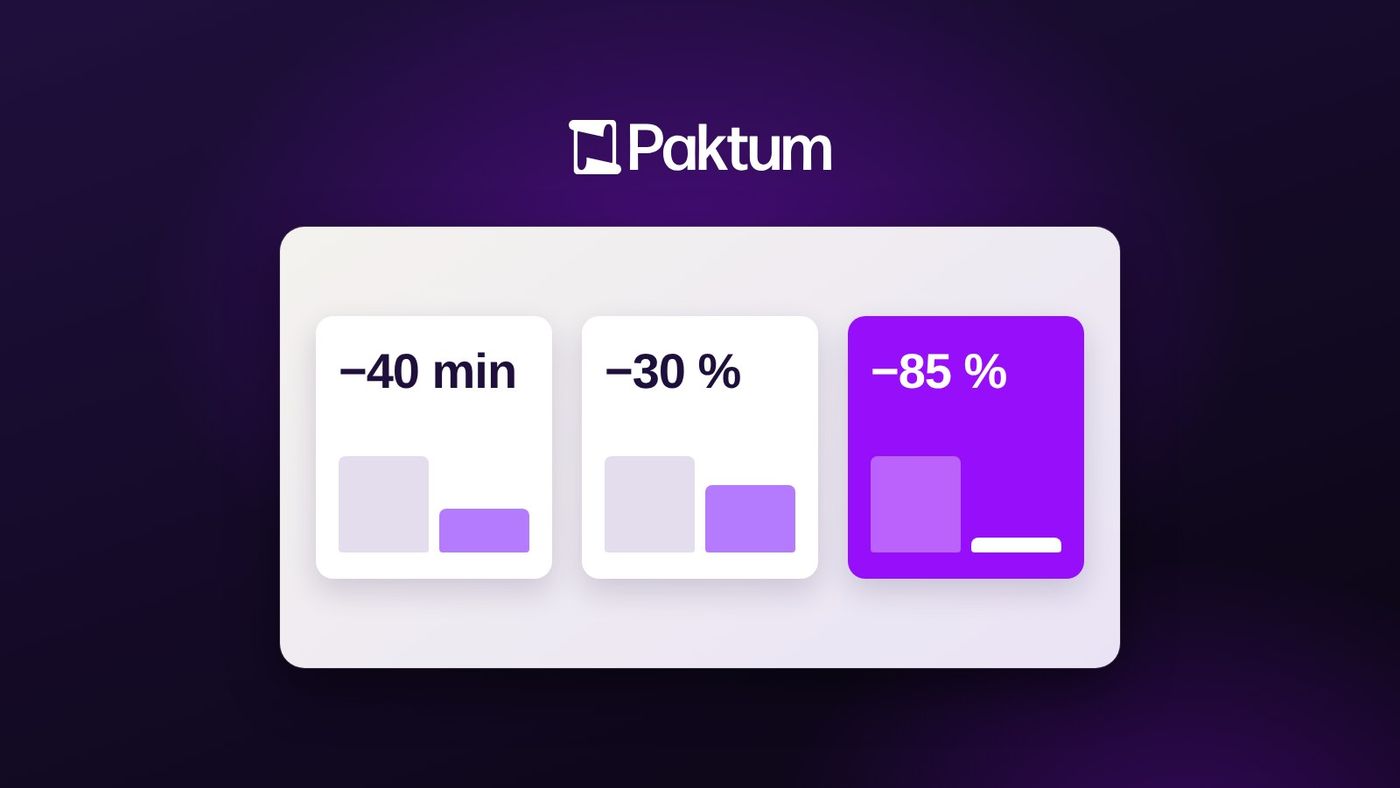
A 2. Bundesliga club cut its invoicing effort by 85% and found 28,500 euros in invoices that had never been issued in the previous season (Paktum customer data, 2023/24 season, anonymised).
Automated invoicing processes save 60 to 80% compared with paper-based processing (Billentis, 2017).
From 1 January 2027, German businesses with more than 800,000 euros in prior-year turnover must issue e-invoices to domestic business customers; from 2028 this applies to all (BMF letter of 15 October 2024; IHK).
The key is a payment schedule in the contract: every instalment, every season invoice and every extra service is entered once and invoiced automatically on its due date.
Where does manual sponsorship invoicing go wrong?
It goes wrong in the transfer: whatever is in the contract has to be copied into an invoice by hand, and every manual step is a source of error. Billentis puts the full cost of a paper invoice on the issuer side at 11.10 euros, compared with 4.50 euros when automated. The model is based on an industrial company and an hourly rate of 60 euros (Billentis, Business Case E-Invoicing, 2017).
Sponsorship makes this harder than an ordinary sales invoice. A single contract often generates several invoices over a season, with different amounts and dates. Typical stumbling blocks:
Instalments: A main sponsor pays in four tranches. The first invoice goes out, the third is forgotten in January.
Season invoices: Multi-year contracts need a new invoice each season, often with a price adjustment. Copy last year's amount and you undercharge.
Extra services: Additional hospitality seats, an extra spot on the LED perimeter boards or a matchday activation are agreed verbally and never invoiced.
Retyping from contracts: Billing address, purchase order number, service period, VAT rate. Every detail is copied from the PDF contract into a Word template.
No overview: Which invoices are due, which are missing? Often only one person knows, with their own Excel list.
The direct cost per invoice is the smaller part. More expensive is the invoice that never gets written. It never shows up on a dunning list, because there is no open item for it.
What was the starting point at the second-division club?
As at many clubs, invoicing before the switch was largely manual: contract data was gathered and copied again for every invoice.
The figures after the switch tell the rest of the story. If effort drops by 85%, most of the previous work was in tasks software can take over: searching for data, copying it, checking it, chasing it. And if 28,500 euros in invoices were missing, there was no reliable mechanism that turned every payment obligation in a contract into an invoice.
This is no criticism of the team. In small club offices, invoicing runs alongside sales, matchdays and partner care, and individual items slip through.
What changed with the switch?
The core of the switch: the invoice is created directly from the contract data, no longer from a template. Whoever enters the contract also defines when what is invoiced. After that, nobody has to remember it.
In Paktum, this works as follows:
Payment schedule in the contract: Every contract gets a payment schedule with instalments, season invoices and extra services. Amounts, due dates and service periods are stored once in the system, not in five files.
Automatic invoice runs: On the due date, Paktum creates the invoice automatically. The January instalment is invoiced even when the person responsible is on holiday.
Extra services as contract items: Anything agreed on top goes into the contract as an item and therefore into the invoicing schedule. Verbal promises without an invoice become visible.
Two further building blocks are part of the setup today, especially with the e-invoicing mandate in mind:
E-invoicing: Invoices can be generated as XRechnung or ZUGFeRD, the two German e-invoice formats under the European standard EN 16931, validated against the official KoSIT rule sets (KoSIT is the German public body that maintains the XRechnung standard).
Handover to accounting: Through an interface to your accounting software or a handover to tools such as sevdesk, Lexware or easybill, invoice data flows on without being entered twice.
If your contract data currently lives in scattered lists, automation starts with a migration. How to set up such a project is described in the 6-step migration from Excel to sponsor management.
What results did the switch deliver?
Invoicing effort fell by 85%, and the club found 28,500 euros in invoices that had never been issued in the previous season (Paktum customer data, 2023/24 season, anonymised). Sales showed measurable effects as well.
Metric | Result after the switch |
|---|---|
Invoicing effort | 85% less |
Invoices never issued in the previous season | 28,500 euros found |
Effort per contract created | 40 minutes less |
Length of the sales process | 30% shorter |
Source: Paktum customer data, 2. Bundesliga club, 2023/24 season (anonymised).
The 28,500 euros deserve a second look. They are not an efficiency gain but revenue the club was owed and would have lost without the change of system.
Gregor Rustige, Managing Director of the Bietigheim Steelers, describes a similar effect at his club: “Paktum saves us time above all when we check unsold inventory and analyse sponsorship statistics. Invoicing with Paktum is much faster and more reliable, and we have more time to acquire new sponsors.” (translated from German)
What does automating invoicing save in general?
According to Billentis, electronic and automated invoicing processes save 60 to 80% compared with paper-based processing (Billentis, 2017). The 85% from the case study is slightly above that range. One likely reason: in sponsorship, besides sending the invoice, the work of gathering contract data disappears.
The Billentis analysis puts direct staff costs for the issuer at 2.50 to 10 euros per outgoing invoice. On the recipient side, in other words at your sponsor, it is 5 to 15 euros per invoice. A clean, structured invoice saves your partner work too.
A fictitious example for context: a club with 150 sponsorship invoices per season saves just under 1,000 euros in process costs under the Billentis model (11.10 instead of 4.50 euros per invoice). That is noticeable but modest. A single forgotten season invoice from a mid-sized partner is often worth more. That is why automation pays off above all through completeness.
Many companies are not there yet with e-invoicing: in 2024, only 55% used e-invoices for outgoing invoices, 25% of them only in individual cases (Bitkom survey of 1,103 companies, December 2024; Bitkom is Germany's digital industry association).
Why does the e-invoicing mandate make this urgent?
Because the transition periods are running out. Since 1 January 2025, domestic businesses in Germany must be able to receive e-invoices. Until the end of 2026, they may still issue “other invoices” (sonstige Rechnungen) such as PDF or paper; in 2027, only if prior-year turnover was no more than 800,000 euros (letter from the Federal Ministry of Finance, BMF, of 15 October 2024, paras. 40, 63 and 64). From 1 January 2028, the obligation to issue e-invoices applies to all domestic B2B invoices (IHK Region Stuttgart, the regional chamber of commerce).
For sponsorship invoices, this means: a PDF file without an embedded data set is not an e-invoice but an “other invoice” (BMF letter of 15 October 2024, para. 7). Structured formats under EN 16931 are valid, such as XRechnung or ZUGFeRD from version 2.0.1, except the MINIMUM and BASIC-WL profiles (para. 30). Invoices of up to 250 euros may still be issued as other invoices (para. 22).
The BMF letter of 15 October 2025 covers format errors: an invoice that does not comply with EN 16931 counts as an other invoice, and the recipient must request a correct e-invoice to claim input VAT (IHK Köln). A format error therefore costs your sponsor time and you a round of corrections.
Note: This is not tax or legal advice. Information as of 2026-10-28. Check your specific obligations with your tax adviser.
What this means for clubs in detail is explained in the article on mandatory e-invoicing for sports clubs.
How do you automate invoicing at your club?
In six steps. The order matters: data first, then automation.
Capture all running contracts: Collect every active contract with term, amount and services. Search inboxes for side agreements and verbal promises too.
Check the previous season: Put the contracts next to the invoices actually issued last season. Every contractual payment without an invoice is a candidate for a follow-up charge. The case study shows how much can add up: 28,500 euros.
Store payment schedules in the contract: Define for each contract which amounts fall due when: instalments, season invoices and extra services as separate items.
Keep master data clean: Billing address, contact person, purchase order number and VAT rate are stored once with the partner, not re-entered on every invoice.
Connect e-invoicing and accounting: Agree with your accounting team whether invoices are sent directly as XRechnung or ZUGFeRD or handed over to your accounting tool. Test one invoice run with one partner before switching everyone over.
Activate and monitor automatic invoice runs: Turn on automatic creation on the due date. In the first months, check every run against the payment schedule.
If you can, schedule the switch for a quiet phase shortly after the end of the season. Fewer invoices fall due then.
For sports marketing agencies there is an extra layer: they invoice on behalf of several clubs or leagues. How this works with separate datasets for each client is shown in the article on sponsor management for marketing agencies.
Conclusion
The case study shows two effects. The first is expected: when invoices are created from contract data, effort drops sharply, by 85% at this second-division club. The second is the one that really matters: automation makes invoicing complete. 28,500 euros that were never invoiced the season before is a clear argument.
With mandatory e-invoicing from 2027 and 2028, manual invoicing becomes even harder. A PDF from a Word template will usually no longer be enough. If you store payment schedules in your contracts now, you solve both issues in one step.
If you want to know how much invoice volume sits in your contracts and whether all of it is actually invoiced, book a demo with Paktum.
Frequently asked questions (FAQ)
What does automated invoicing mean in sponsorship?
Invoices are created directly from contract data. The contract holds a payment schedule with instalments, season invoices and extra services. On the due date, the system generates the invoice automatically, with the right amounts, service periods and partner details. Nobody has to retype data from PDF contracts or keep due dates in a calendar any more.
How much time does automating invoicing save?
In the case of a 2. Bundesliga club, invoicing effort fell by 85% (Paktum customer data, 2023/24 season, anonymised). General process cost analyses by Billentis arrive at savings of 60 to 80% compared with paper-based processing. How much you save depends on the number of contracts, the complexity of your payment schedules and your current process.
How do you find invoices that were never issued?
By matching every contractual payment obligation against the invoices actually issued. Done manually, that means putting all of last season's contracts next to your outgoing invoices and checking item by item. With a payment schedule in the system, this check runs continuously. In the case study, it involved 28,500 euros that had never been invoiced in the previous season.
Does my club have to issue sponsorship invoices as e-invoices?
For domestic B2B invoices in Germany, generally yes, with transition periods. Until the end of 2026, PDF and paper are still permitted; in 2027 only with no more than 800,000 euros in prior-year turnover; from 2028 the obligation applies to all (BMF letter of 15 October 2024; IHK). Invoices up to 250 euros are exempt. This is not tax advice, so check your case with your tax adviser.
Can I keep using my existing accounting software?
Yes. Sponsorship management software does not replace financial accounting, it feeds it clean data. Paktum creates the invoice from the contract and hands it over via an interface to your accounting software or to tools such as sevdesk, Lexware or easybill. Your tax adviser keeps their usual workflow, and nobody enters invoice data twice.
Sources
Billentis (Bruno Koch), Business Case E-Invoicing / E-Billing (February 2017), accessed 28 October 2026, https://billentis.com/assets/reports/e-invoicing-businesscase.pdf
Federal Ministry of Finance (BMF), letter “Ausstellung von Rechnungen nach § 14 UStG; Einführung der obligatorischen elektronischen Rechnung bei Umsätzen zwischen inländischen Unternehmern ab dem 1. Januar 2025” (15 October 2024), provided by the IHK, accessed 28 October 2026 (in German), https://www.ihk.de/blueprint/servlet/resource/blob/6287096/b75ea97a08683f14991b4315c44fee1c/bmf-schreiben-15-10-2024-e-rechnung-data.pdf
IHK Köln, BMF-Schreiben zur E-Rechnung vom 15.10.2025, accessed 28 October 2026 (in German), https://www.ihk.de/koeln/hauptnavigation/recht-steuern/steuern/bmf-schreiben-zur-e-rechnung-vom-15-10-2025-6774012
IHK Region Stuttgart, E-Rechnungen: Ende der Übergangsfrist für Unternehmen mit mehr als 800.000 Euro Umsatz, accessed 28 October 2026 (in German), https://www.ihk.de/stuttgart/fuer-unternehmen/recht-und-steuern/steuerrecht/steuermeldungen/e-rechnungen-5864496
Bitkom, Weniger als die Hälfte deutscher Unternehmen empfängt E-Rechnungen (3 December 2024), accessed 28 October 2026 (in German), https://www.bitkom.org/Presse/Presseinformation/Weniger-als-die-Haelfte-deutscher-Unternehmen-empfaengt-E-Rechnungen
Paktum, customer data from a project at a 2. Bundesliga club, 2023/24 season (internal analysis, anonymised)
Paktum, customer quote from Gregor Rustige, Bietigheim Steelers (website)