
Only 37% of marketers have a standardised process for measuring the return on their sponsorship. At the same time, 78% say validated results have become more important to them (ANA/MASB, 2018). For your club, that means: if the sponsor does not measure, gut feeling decides the renewal. Or the numbers you bring to the table.
At Paktum we build sponsorship management software for clubs, leagues and agencies. This article covers the five metrics we consider decisive in practice, each with a formula, a worked example and the typical mistakes. The full process is described in the complete guide to sponsorship management.
Key takeaways
Only 37% of marketers measure sponsorship return with a standardised process, and only 40% write measurement expectations into their contracts with rights holders (ANA/MASB, 2018).
62% of marketers say it is extremely or very important that the rights holder provides measurement information (ANA/IEG, 2010).
Five metrics are enough to start: visibility and reach, value per contact, activation rate, renewal rate and administrative effort.
The backlog curve shows contractually secured revenue per season. In Olympic and World Cup sponsorships, partnerships are most likely to end within the first two renewal periods (Jensen and Turner, 2017).
What does sponsorship ROI mean for a club?
For a club, sponsorship ROI has two sides: the value you deliver to your partner, and what is left for the club after all costs. A partner who sees no value cancels or pushes the price down. A deal that costs you more in hospitality, production and staff time than it brings in is not a good deal either.
Classic ROI is calculated in money: return minus investment, divided by investment. In sponsorship this quickly reaches its limits, because image and awareness rarely translate directly into sales. That is why many sponsors work with ROO, return on objectives: objectives are defined before the investment, weighted by priority and assessed together at the end (Sponsorium, 2026). ANA/MASB also separates ROI metrics such as financial return and product sales from ROO metrics such as brand awareness and brand attitudes (ANA/MASB, 2018).
As a rights holder, ROO is the more practical route. You do not know your partner’s sales figures, but you can agree objectives with them and deliver the evidence. That pays directly into renewals and pricing: if you can prove what you delivered, you negotiate on value instead of discounts.
Which 5 metrics actually matter?
Three metrics show the value for the partner, two show the economics for your club. The overview:
Metric | Formula | Data source | How often to measure |
|---|---|---|---|
Visibility and reach | Sum of contacts per channel | Ticketing, platform statistics, media review | monthly |
Value per contact (CPM) | Sponsorship fee ÷ contacts × 1,000 | Contract, reach data | every six months and at season end |
Activation rate | Benefits used ÷ benefits agreed × 100 | Contract, delivery records | monthly |
Renewal rate | Contracts renewed ÷ contracts expiring × 100 | Contract data | per season, before renewal talks |
Administrative effort | Admin costs ÷ sponsorship revenue × 100 | Time tracking, accounting | quarterly |
All examples below are fictitious and rounded.
1. Visibility and reach
This metric measures how often your partner’s brand was actually seen.
Formula: Contacts per season = stadium attendance + stream and TV reach + social media impressions featuring the partner + other channels
Example: 15 home games with 4,000 spectators each give 60,000 contacts. The live stream adds 15 × 6,000 = 90,000. On top come 850,000 impressions on posts with the partner’s logo. Total: 1,000,000 contacts.
Data sources: ticketing, platform statistics, figures from your streaming partner and a media review (in German, Medienspiegel). The German club advice portal vibss describes the media review as a kind of sponsorship MOT (vibss, 19 June 2025, in German).
Pitfall: Converting contacts into an advertising value (media value, AVE or EMV) is contested. The Barcelona Principles 4.0 of the measurement association AMEC classify such advertising value equivalents as an invalid measure (AMEC, June 2025). Media value cannot tell you “whose eyeballs they were or what action they took next” (The Sponsor, 29 September 2025).
2. Value per contact
Value per contact shows how efficient a package is compared with other packages. The usual yardstick is cost per thousand contacts (CPM, in German Tausend-Kontakt-Preis or TKP), the cost of 1,000 impressions (Haufe Akademie, glossary).
Formula: Cost per contact = sponsorship fee ÷ number of contacts. CPM = sponsorship fee ÷ number of contacts × 1,000
Example: The partner from example 1 pays 50,000 euros per season. 50,000 ÷ 1,000,000 × 1,000 gives a CPM of 50 euros, or 5 cents per contact.
Data sources: the contract value and the contacts from metric 1.
Pitfall: Against online advertising, a club often looks poor on CPM, because hospitality, exclusivity and regional proximity are missing from the number. Compare CPM within your own portfolio and across several seasons. If two similar packages have very different CPMs, the price is usually wrong.
3. Activation rate
The activation rate measures what share of the agreed benefits was actually delivered and used. It shows early on whether a partner is really living the partnership, long before the renewal talk comes up.
Formula: Activation rate = benefits used ÷ benefits agreed in the contract × 100
Example: A package includes 20 benefits: hospitality on ten matchdays, six social media posts, two competitions and two matchday promotions. 14 of them were used: 70%.
Data sources: the list of benefits in the contract, documented delivery with photos, hospitality guest lists.
Pitfall: Many clubs only count what they delivered. What the partner does not take up matters just as much. Empty box seats are a warning sign. Conversely, activation shows commitment: activation, staff and hospitality can push the total cost to two or three times the rights fee (Sponsorium, 2026).
4. Renewal rate
The renewal rate shows how many expiring contracts are renewed. It is your partners’ most honest verdict on your work.
Formula: Renewal rate = contracts renewed ÷ contracts expiring × 100. Value-based: volume renewed ÷ volume expiring × 100
Example: 25 contracts expire, 19 are renewed: 76%. By value, it is 340,000 of 400,000 euros, or 85%. Smaller partners left, the large ones stayed.
Data sources: contract data with terms, notice periods and cancellations.
Pitfall: Automatic renewals flatter the rate. Report them separately. And split by contract age: in Olympic and World Cup sponsorships, partnerships are most likely to end within the first two renewal periods (Jensen and Turner, Sport Marketing Quarterly, 2017). New partners need more attention than long-standing ones.
5. Administrative effort
This metric measures what a sponsorship contract costs you internally, from the proposal to the payment reminder.
Formula: Admin cost per contract = admin hours × hourly rate ÷ number of contracts. Admin ratio = admin costs ÷ sponsorship revenue × 100
Example: 600 hours per season at 50 euros come to 30,000 euros. With 60 contracts that is 500 euros per contract, and with 1,200,000 euros in sponsorship revenue an admin ratio of 2.5%.
Data sources: time tracking or an honest estimate per process step, plus accounting.
Pitfall: The most expensive admin never shows up on a timesheet: the invoice that was never issued. A club in Germany’s 2. Bundesliga (second division) found 28,500 euros in invoices from the previous season that had never been issued when it switched systems (Paktum customer data, season 23/24, anonymised). More in the case study on sponsorship invoicing.
How do you plan with forecasts and the backlog curve?
You plan along two axes: contractually secured revenue and weighted pipeline. The first shows what is already in place, the second what can realistically be added.
The most important chart is the backlog curve. It shows which revenue per season is secured by signed contracts. Because contracts expire, it drops in future seasons. This “cliff” is your sales target: renew or sell new deals before the gap opens.
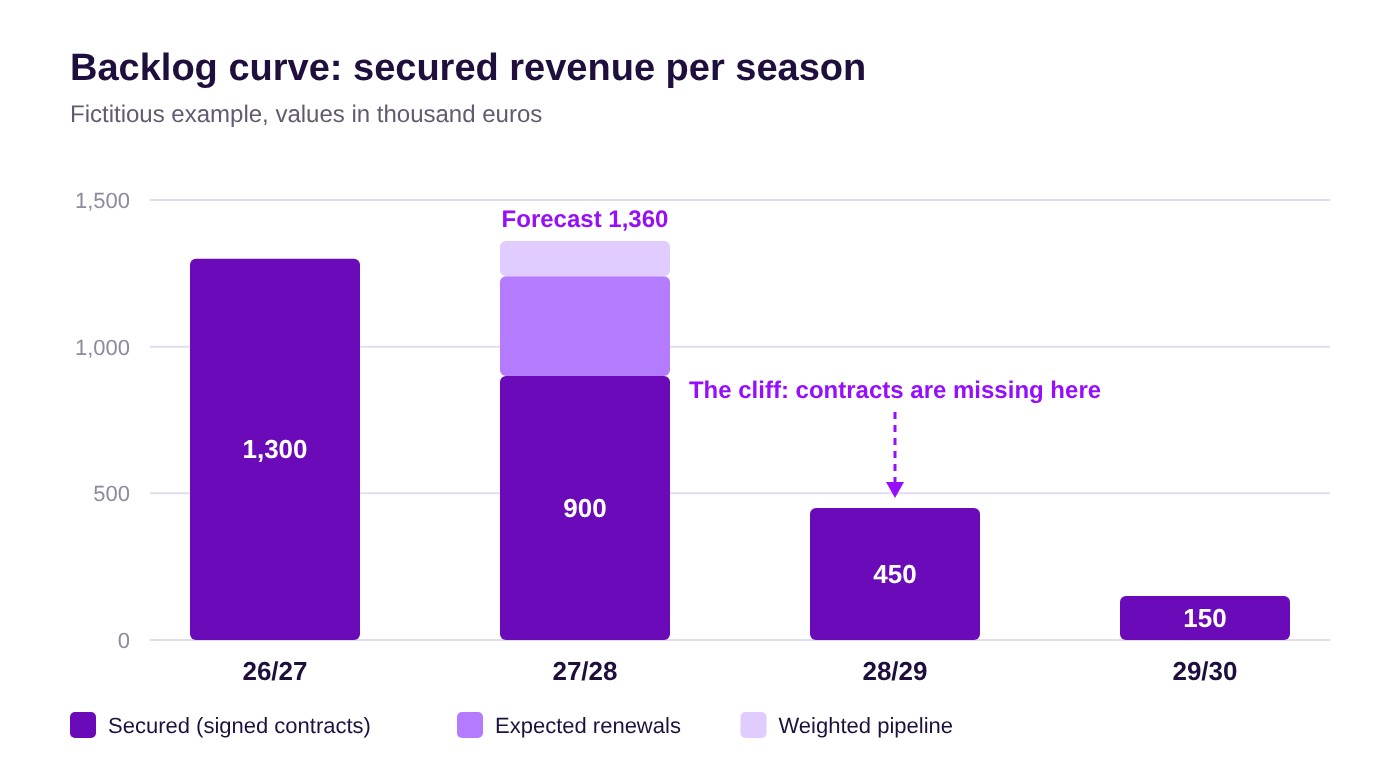
The run-to-term logic applies: a cancelled contract keeps counting until the actual end of its term, because the revenue is secured until then.
Formula: Forecast per season = secured revenue + expiring volume × expected renewal rate + sum of (deal value × probability of closing)
Example: 900,000 euros are secured for next season. 400,000 euros expire, and at an 85% renewal rate you expect 340,000 euros. Open deals worth 300,000 euros with an average probability of 40% bring 120,000 euros. Forecast: 1,360,000 euros.
Be careful with a flat rate. Sponsorship forecasts mostly rely on the renewal rate, and depending on the method, revenue projections in Jensen and Turner’s study differed by as much as 100 million US dollars (2017). Use separate rates for new and long-standing partners.
Fabian Huber, Marketing at PS Karlsruhe LIONS: “The CRM function was especially important to us: it lets us follow up on contacts and build reliable forecasts.”
How to measure this in practice
Start small and expand your measurement season by season:
Start small: two or three metrics, your five most important partners. Activation rate and renewal rate only need contract data.
Agree objectives: before the season starts, record with each partner what the partnership should achieve. Only 40% of marketers write measurement expectations into the contract (ANA/MASB, 2018). Suggest it yourself.
Define a baseline: use the previous season as the starting value. If data is missing, the first four weeks serve as the baseline.
Assign responsibility: one name per data source, from attendance figures to delivery photos.
Report monthly: one page per partner with contacts, delivered benefits and open items.
Review the season before negotiating: the season report is ready before the notice window opens.
Adjust prices: use CPM and activation rate for next season’s rate card.
If your sponsorship management still lives in spreadsheets, the article on migrating from Excel to sponsorship management software describes the switch.
What belongs in the season report to the sponsor?
The season report should contain everything your partner needs to justify the partnership internally. 62% of the marketers surveyed consider measurement information from the rights holder extremely or very important. Most sought after are audience demographics (85%), research on sponsor recall (72%) and on attitudes towards sponsors (70%) (ANA/IEG, survey May 2010).
A good season report contains:
Benefits overview: all agreed benefits with their status, delivered or open.
Reach and audience: contacts per channel compared with last season, plus age and gender where available.
Activations with evidence: photos of boards, promotions and hospitality, screenshots of posts.
Media review: articles and reports in which the partner appears.
Objectives achieved: the agreed objectives with results.
Outlook: proposals for next season, ideally with a package idea.
vibss recommends a digital documentation folder at the end of a project, with printed materials, visitor data, media coverage, photos and results of spectator surveys (vibss, 26 June 2025). Agencies also produce such reports for the club, as the article on sponsorship management for marketing agencies shows.
How does Paktum help with measurement?
Paktum combines partner management, rights management, contract management, invoicing and controlling in one system. The data for all five metrics sits in one place.
Contracts and benefits: terms, notice periods, automatic renewal and documented delivery.
Inventory: allocations per season, double-booking protection and a visual position and stadium planner.
Controlling: real-time controlling, forecasts and the backlog curve with run-to-term logic.
Invoices: created automatically from payment schedules when they fall due.
Gregor Rustige, Managing Director of the Bietigheim Steelers: “Paktum saves us time above all when we check unsold inventory and analyse sponsorship statistics. Invoicing with Paktum is much faster and more reliable, and we have more time to acquire new sponsors.” (translated from German)
Conclusion
For a club, sponsorship ROI is not a single number. It is the proof of the value you deliver to your partners, and the calculation of what you keep. Five metrics are enough, from reach to administrative effort.
Most sponsors do not measure systematically themselves. That is your opportunity: if you agree objectives, report regularly and arrive with numbers before the notice window, you negotiate on value instead of discounts.
If you want to see your metrics and forecasts in one place, book a demo with Paktum.
Frequently asked questions (FAQ)
How do you calculate the ROI of a sponsorship?
The classic formula is ROI = (return minus investment) ÷ investment × 100. In sponsorship, the return is often not directly measurable. As a club, you therefore calculate two things: the value for the partner through reach, value per contact and activation, and your own return after deducting delivery costs and administrative effort.
What is the difference between ROI and ROO?
ROI measures the financial return on an investment. ROO, return on objectives, measures whether objectives set in advance were achieved, such as awareness, leads or brand attitudes. The objectives are defined before the investment and weighted by priority (Sponsorium, 2026). For clubs, ROO is usually more practical, because they do not know their partners’ sales figures but can prove what was achieved.
Is media value a good sponsorship metric?
Only to a limited extent. Media value converts logo exposure into a notional advertising value. The Barcelona Principles 4.0 of the measurement association AMEC classify advertising value equivalents such as AVE and EMV as invalid measures (AMEC, June 2025). Use contacts and reach, but not as a euro equivalent, and add activation rate and objectives achieved.
What is a good renewal rate?
There is no reliable public benchmark. Compare your rate with your own previous seasons, by number and by value. Report automatic renewals separately and pay particular attention to young partnerships: in Olympic and World Cup sponsorships, they are most likely to end within the first two renewal periods (Jensen and Turner, 2017).
How often should I report to my sponsors?
A sensible rhythm is a short monthly report with contacts, delivered benefits and open items, plus a detailed season report. The season report should be ready before the notice window, so it feeds into the renewal decision. With large partners, a meeting at the halfway point of the season is also worthwhile, while smaller partners receive a compact report.
Sources
ANA, Sponsorship Measurement Needs Improvement: Study (ANA/MASB, 10 July 2018), accessed 28 October 2026, https://ana.net/content/show/id/pr-2018-sponsorship-measurement
MASB, ANA/MASB Report Says Sponsorship Measurement Needs Improving (16 July 2018), accessed 28 October 2026, https://themasb.org/ana-masb-report-says-sponsorship-measurement-needs-improving/
ANA, Marketers Want Sponsorship and Event Metrics but Lack Necessary Capabilities, ANA/IEG Survey Shows (survey May 2010), accessed 28 October 2026, https://ana.net/content/show/id/pr-2010-want-metrics
Sponsorium (Marie-Ève Beaucher), ROI vs ROO: The legitimate measure for evaluating Sponsorship returns (26 June 2026), accessed 28 October 2026, https://www.sponsor.com/roi-vs-roo-the-legitimate-measure-for-evaluating-sponsorship-returns/
AMEC, Barcelona Principles V4.0 (June 2025), accessed 28 October 2026, https://amecorg.com/wp-content/uploads/2025/06/Barcelona-Principles-V4.0-%E2%80%93-FINAL30.6-compressed.pdf
The Sponsor (Sean Connell), Media value vs market value: How to correctly price sponsorship (29 September 2025), accessed 28 October 2026, https://www.thesponsor.com/media-value-vs-market-value-how-to-correctly-price-sponsorship
Jonathan A. Jensen and Brian A. Turner, Advances in sport sponsorship revenue forecasting: an event history analysis approach, Sport Marketing Quarterly 26 (2017) 1, pp. 6 to 19, record in BISp SURF, accessed 28 October 2026, https://www.bisp-surf.de/Record/PU201704002773
Haufe Akademie, Glossar: Tausenderkontaktpreis, accessed 28 October 2026, https://www.haufe-akademie.de/blog/glossar/tausenderkontaktpreis (in German)
vibss, Sponsoring-Erfolgskontrollen: Medienspiegel (19 June 2025), accessed 28 October 2026, https://www.vibss.de/vereinsmanagement/marketing/sponsoring/sponsoring-erfolgskontrolle/medienspiegel?type=123 (in German)
vibss, Sponsoring-Erfolgskontrollen: Dokumentation umgesetzter Massnahmen (26 June 2025), accessed 28 October 2026, https://www.vibss.de/vereinsmanagement/marketing/sponsoring/sponsoring-erfolgskontrolle/dokumentation-umgesetzter-massnahmen?type=123 (in German)
Paktum, customer data from a project with a 2. Bundesliga club, season 23/24 (internal analysis, anonymised)
Paktum, customer quotes from Gregor Rustige (Bietigheim Steelers, website) and Fabian Huber (PS Karlsruhe LIONS)